


Who is a Financial Data Scientist? Roles, Skills, and Career Path | IABAC

A financial data scientist is a professional who uses data to help companies make better financial decisions. They analyze numbers, market trends, and business information to understand what is happening and what might happen in the future. This role combines knowledge of finance with skills in data analysis and technology.
Students and professionals who are interested in both money and data often choose this career. Before getting into this field, it is helpful to know what a financial data scientist does, the skills required, and how to build a career in this area.
What is a Financial Data Scientist?
A financial data scientist is someone who applies data science methods, statistical analysis, machine learning models, and financial knowledge to solve real-world financial problems. This role sits at the intersection of business strategy and advanced analytics.
Using large amounts of financial data, these professionals:
-
Identify patterns and trends
-
Analyze business risks and opportunities
-
Create predictive models to forecast outcomes
-
Help companies make informed financial decisions
In simple terms, a financial data scientist helps organizations understand financial past trends, evaluate the present situation, and predict future outcomes using data-driven techniques.
Why Are Financial Data Scientists Becoming Essential?
The financial industry has transformed significantly. Traditional financial decision-making relied heavily on experience and historical patterns. But the environment today includes fast market movements, digital transactions, automated trading, and increasing financial risks. Companies need precise, timely, and data-supported insights to stay competitive.
This is where the role of a financial data scientist becomes crucial. They provide clarity in uncertainty by basing decisions on data patterns instead of assumptions. As a result, financial institutions, fintech companies, and corporate finance teams actively seek professionals skilled in both finance and analytics.
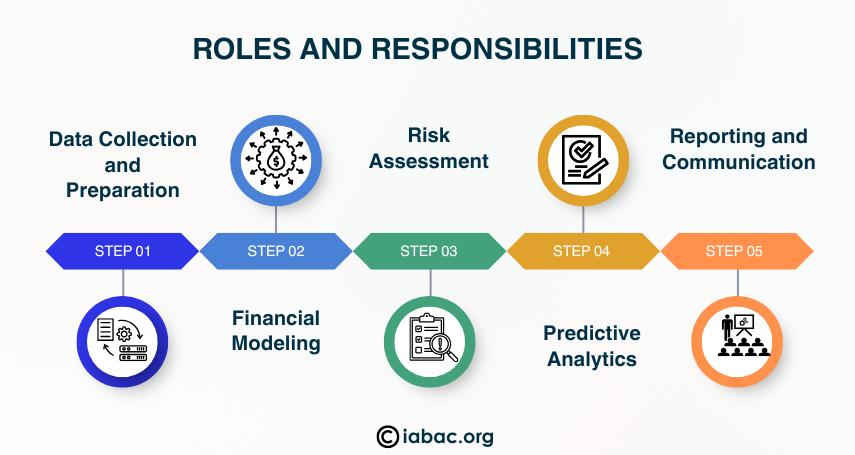
Roles and Responsibilities
The responsibilities of a financial data scientist may vary from one organization to another, but some common duties include:
-
Data Collection and Preparation
Gathering financial data from internal systems, market reports, and public databases, then cleaning and organizing it for analysis. -
Financial Modeling
Creating mathematical and statistical models to forecast revenue, costs, market trends, investment outcomes, and business growth. -
Risk Assessment
Analyzing customer behavior, credit risk, fraud likelihood, and operational risks to support safer decision-making. -
Predictive Analytics
Using machine learning techniques to predict future financial patterns such as stock price movement, customer churn, or loan default chances. -
Reporting and Communication
Creating clear reports, dashboards, and presentations that help business leaders understand insights and take actions.
In brief, their role is to convert complex data into meaningful financial guidance.
Where Do Financial Data Scientists Work?
A financial data scientist can work in several industries, including:
-
Banking and credit institutions
-
FinTech and digital payment companies
-
Investment firms and stock trading organizations
-
Insurance companies and risk advisory firms
-
Corporate finance departments in large businesses
Because every financial organization deals with data, the opportunities are widespread.
Skills Required to Become a Financial Data Scientist
This role requires a balanced combination of technical, financial, and communication skills.
Technical Skills
-
Python or R for data analysis and modeling
-
SQL for working with large datasets
-
Excel for financial calculations
-
Machine learning and statistical modeling
-
Data visualization using tools like Tableau or Power BI
Financial Knowledge
-
Understanding financial statements and business performance indicators
-
Awareness of stock markets, trading concepts, and investment strategies
-
Knowledge of corporate finance and budgeting principles
-
Ability to evaluate financial risks and returns
Soft Skills
-
Problem-solving and logical reasoning
-
Clear communication for explaining insights
-
Ability to work with cross-functional teams
-
Analytical thinking and curiosity
Career Path to Becoming a Financial Data Scientist
Anyone passionate about finance and analytics can work towards this career one step at a time.
-
Start with Finance Basics
Learn how companies manage money, investments, and financial statements. -
Develop Data and Programming Skills
Learn Python, SQL, and tools for data analysis and visualization. -
Practice on Real Financial Datasets
Work on projects such as loan prediction, fraud detection, or stock price forecasting. -
Build a Portfolio
Share your projects through platforms like GitHub, Kaggle, or LinkedIn. -
Gain Internship Experience
Apply for roles in banks, fintech startups, or analytics firms. -
Grow in Professional Roles
Progress from Analyst → Data Analyst → Financial Data Scientist → Senior and Leadership positions.
Salary and Growth Potential
The earning potential for a financial data scientist is strong because of the level of responsibility and skill required. With experience, the role can advance into:
-
Lead Data Scientist
-
Quantitative Analyst (Quant)
-
Risk Modeling Manager
-
Investment Strategy Consultant
-
Chief Data Officer
Growth is steady, and the role remains relevant as financial technology evolves.
Why This Career Has a Strong Future
The finance sector is shifting toward AI-powered decision-making, digital banking, blockchain systems, and algorithmic trading. All of these developments rely on data. As digital transactions increase, so does the volume of financial data that needs to be understood and utilized.
This ensures that the need for financial data scientists will continue to grow. It is a career that remains strong as long as financial systems operate on data—which is always.
Conclusion
A financial data scientist is a critical professional in modern finance. By blending data science with financial understanding, they help organizations make smarter decisions, manage risks better, and plan future strategies confidently.
If you enjoy working with numbers, solving complex problems, analyzing patterns, and contributing to major financial decisions, then pursuing a career as a financial data scientist may be the right direction. With the right training, practice, and continuous learning, you can build a successful and future-ready career in this field.
Categories
Read More
Last Z: Survival Shooter offers more than just simple tap-to-shoot gameplay; it combines intense real-time shooting with strategic base-building elements. Players battle waves of zombies in side-scrolling shooter levels, then switch gears to a top-down view where they develop their base, gather survivors, and manage crucial resources. This dynamic gameplay thrives with improved controls and a...

For players eager to enhance their PUBG Mobile experience without cost, official redeem codes are a prime resource. ' These promotional keys, distributed through sanctioned events and partnerships, provide a direct path to premium items. ' Valid codes unlock a variety of in-game assets, including Unknown Cash (UC), cosmetic skins, outfit sets, and Elite Pass tiers. ' The availability is...
Magical Harry Potter Collectibles Prepare for a wave of miniature magic and plush enchantment. Spin Master casts a new spell on beloved Potterverse icons. Interactive Hedwig and a detailed Hogwarts castle lead the charming charge. This collection reimagines classic wizarding moments for imaginative play. Discover a lineup designed to delight the next generation of young witches and wizards....
Harry Potter Children's Eyewear Discover the latest children's eyewear collection inspired by Harry Potter, now available from Pair Eyewear. This new line features playful frames inspired by the four Hogwarts houses, designed to appeal to young fans. With vibrant colors and unique styles, these glasses bring the magic of Hogwarts right to your child's daily accessories. The collaboration...
The journey of Black Myth: Wukong nears its end, with a final trailer revealing its polished form. Launching on PC and PlayStation 5 this August, the game displays combat of unprecedented speed and fluidity. Vast landscapes unfold, from icy lakes to golden forests, teeming with formidable adversaries. Key story moments and characters are also glimpsed, all captured directly from the working PC...