


Service Pricing Guide: How to Quote Charges Confidently (With Prompts)
The Ultimate Hack (One-Line Truth)
You do not quote a price for the service. You quote a price for the outcome, adjusted by risk, urgency, and client profile.
Everything below operationalizes this idea.
Step 1: Classify the Client Before the Work
Before calculating anything, determine who you are pricing for.
| Client Type | Mindset | Pricing Rule |
|---|---|---|
| Cost-driven | Compares vendors | Quote tight, minimal scope |
| Value-driven | Wants reliability | Quote mid + credibility |
| Outcome-driven | Wants results | Quote high + guarantee |
| Ego / Status-driven | Wants the “best” | Premium or walk away |
Hack:
If the client asks “Why so expensive?” → they are not premium.
If they ask “How fast can you do it?” → price goes up immediately.
Step 2: Calculate Your Non-Negotiable Base Price
This is your survival number. Never quote below this.
Formula:
(Monthly income goal + Overheads) ÷ Billable days ÷ Efficiency factor
Example:
-
Monthly target: ₹3,00,000
-
Overheads: ₹50,000
-
Billable days: 20
-
Efficiency factor: 0.7
(3,50,000 ÷ 20) ÷ 0.7 ≈ ₹25,000/day
This is your minimum mental anchor.
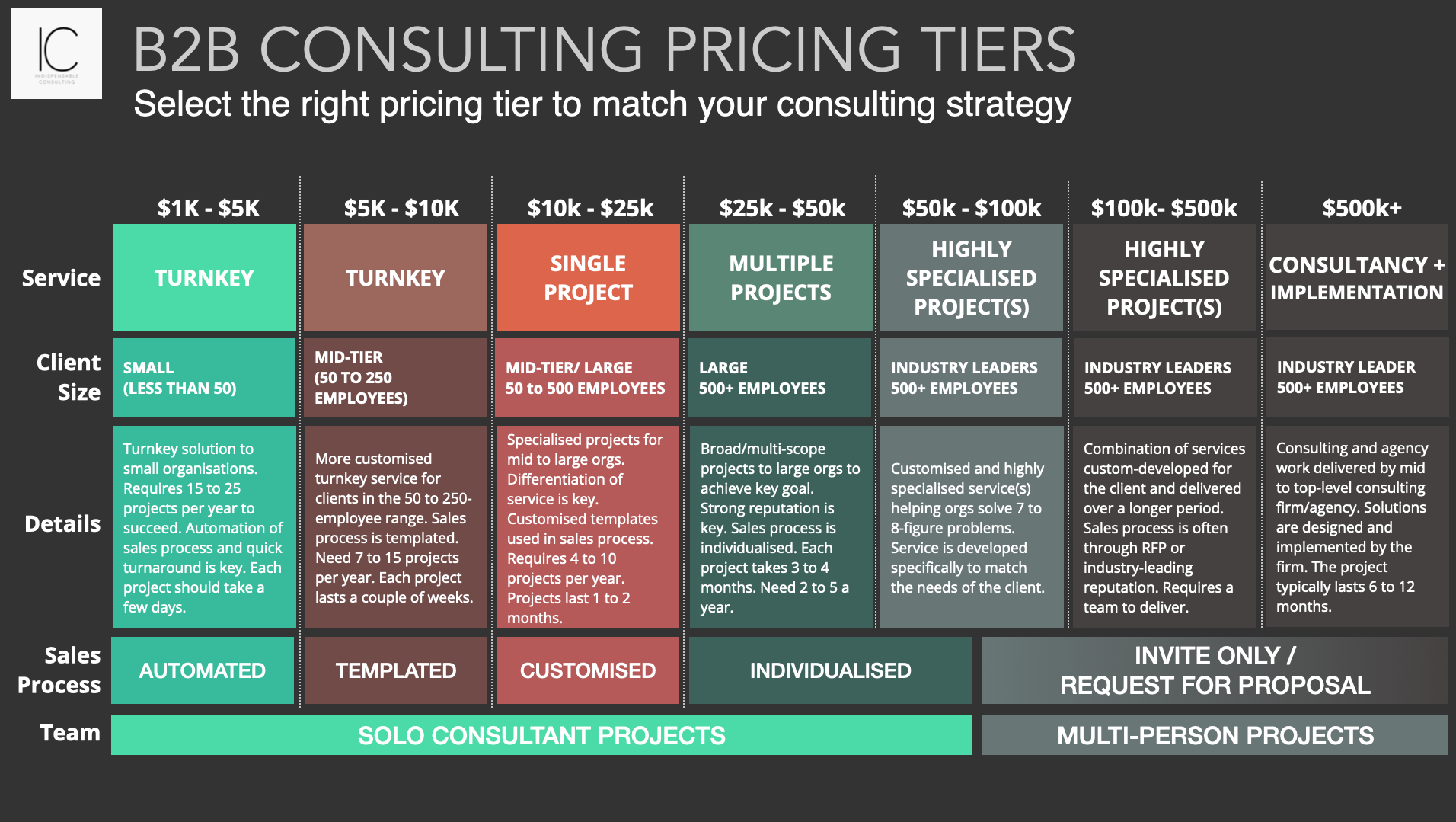
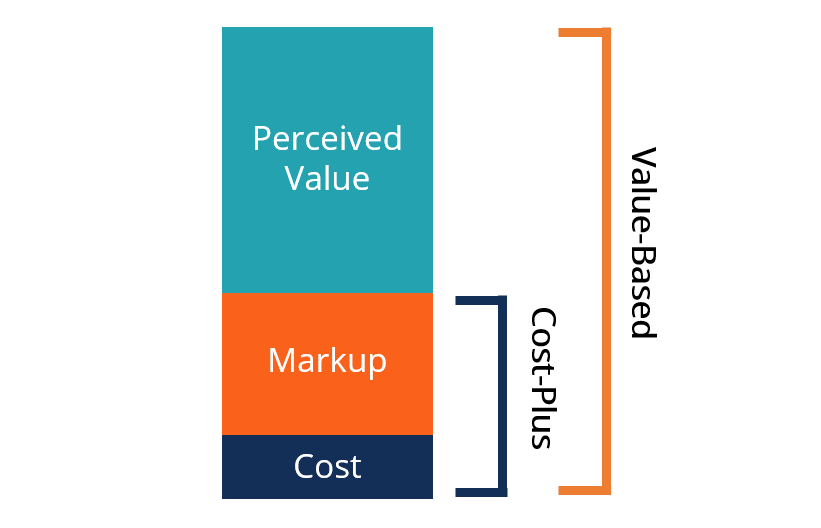
Step 3: Price the Problem, Not the Task
Clients don’t pay for what you do. They pay for what happens if you don’t.
Ask:
-
What happens if this is delayed?
-
What does success unlock for them?
-
What is the cost of failure?
Then price as a percentage of value created or risk avoided.
| Value to Client | Safe Quote Range |
|---|---|
| ₹1–5 lakh | ₹30k–₹60k |
| ₹5–20 lakh | ₹1–3 lakh |
| ₹20L+ | ₹5L+ or retainer |
Hack:
If your price feels “high”, but failure costs them more → it’s underpriced.
Step 4: Apply the 5 Price Multipliers
Start with your base price and multiply.

| Factor | Multiplier |
|---|---|
| Urgency (“need it fast”) | ×1.25 – ×2 |
| Complexity / uncertainty | ×1.2 – ×1.5 |
| Client brand / size | ×1.3 – ×3 |
| Accountability / guarantees | ×1.2 – ×2 |
| Experience gap (you vs others) | ×1.5 – ×4 |
Example:
Base ₹50,000 × Urgency (1.5) × Brand (2) = ₹1,50,000
Step 5: Offer 3 Options (This Is the Real Hack)
Never quote a single number.
| Package | Price | Psychology |
|---|---|---|
| Basic | ₹X | Anchors low |
| Recommended | ₹2X | Chosen most |
| Premium | ₹3–4X | Makes others look reasonable |
Rules:
-
Always highlight Recommended
-
Premium must feel exclusive
-
Basic must feel slightly uncomfortable
Step 6: Quote With Authority (Language Matters)
Never say:
-
“This is negotiable”
-
“Let me know your budget”
-
“I can reduce scope”
Say instead:
-
“This pricing reflects the outcome and responsibility involved”
-
“We can adjust timelines or deliverables, not quality”
-
“This is the correct price for this level of execution”
Hack:
Silence after quoting is power. Let the client respond first.
Step 7: Build Negotiation Buffers Invisibly
Add buffers before the quote, not after objections.
-
Inflate internal estimate by 15–25%
-
Split price into phases
-
Add optional paid add-ons
If they negotiate → you “remove” something, not money.
Step 8: Know When to Walk Away
If:
-
They disrespect pricing
-
Compare you aggressively
-
Delay payment terms
-
Say “others are cheaper”
Then walking away increases your brand value.
Counter-intuitive truth:
Your best clients come after you reject bad ones.
The Ultimate Pricing Checklist
Before sending a quote, confirm:
-
Did I price the outcome?
-
Did I apply urgency and risk?
-
Did I offer 3 options?
-
Does this price slightly scare me? (Good sign)
-
Can I confidently defend this number?
If yes → send it.
Final Thought
The real hack is this:
People don’t buy services. They buy confidence transferred through pricing.
Here are the prompts
1. Self-Clarity Prompts (Before Quoting Anything)
These prompts help students avoid the biggest mistake: guessing prices emotionally.
Thinking Prompts
-
What exact problem am I solving?
-
What will the client gain if this works?
-
What happens if the client delays or fails without my help?
-
Is this a one-time task or ongoing responsibility?
-
Am I being paid for effort or for judgment?
Copy-Paste AI Prompt
“I am a student offering a service. Break down the real value of my service beyond hours worked and explain what the client is actually paying for.”
2. Cost & Time Reality Prompts (Avoid Undercharging)
Students often ignore hidden costs.
Thinking Prompts
-
How many total hours (including learning, revisions, communication)?
-
What tools, subscriptions, or resources am I using?
-
What opportunity am I losing by taking this project?
Copy-Paste AI Prompt
“Calculate a fair minimum price for my service considering time spent, learning effort, revisions, communication overhead, and opportunity cost.”
3. Skill-Level Confidence Prompts (Imposter Syndrome Killer)
Students undervalue themselves because they focus on “experience.”
Thinking Prompts
-
Can the client do this themselves?
-
Will a mistake here cost them time, money, or reputation?
-
Am I faster or clearer than a beginner?
Copy-Paste AI Prompt
“Reframe my current skill level into market value, even though I am a student or beginner, and suggest a confident pricing range.”
4. Market Comparison Prompts (Without Copying Prices Blindly)
The goal is positioning, not imitation.
Thinking Prompts
-
Who else does this service?
-
What do low-quality providers miss?
-
What am I doing better or differently?
Copy-Paste AI Prompt
“Compare my service offering with typical market alternatives and suggest where I can price myself without racing to the bottom.”
5. Outcome-Based Pricing Prompts (The Ultimate Upgrade)
This shifts students from hourly pricing to value pricing.
Thinking Prompts
-
What result will the client see after delivery?
-
Is this result measurable (leads, grades, traffic, conversions)?
-
How important is this outcome to them?
Copy-Paste AI Prompt
“Convert my service from hourly/task-based pricing into outcome-based pricing and suggest what I should charge.”
6. Risk & Responsibility Prompts (Why Higher Prices Are Justified)
Responsibility increases value.
Thinking Prompts
-
What happens if I mess this up?
-
Am I handling client data, deadlines, or reputation?
-
Will the client blame me if it fails?
Copy-Paste AI Prompt
“Assess the risk and responsibility involved in my service and adjust the pricing upward accordingly.”
7. Urgency & Deadline Prompts (Fast Work = Premium)
Students forget urgency is billable.
Thinking Prompts
-
Is this needed immediately?
-
Am I sacrificing other work or studies?
-
Will delays hurt the client?
Copy-Paste AI Prompt
“Increase my service price fairly based on urgency, short deadlines, or last-minute requests.”
8. 3-Tier Package Creation Prompts (Student Power Move)
This makes students look professional instantly.
Thinking Prompts
-
What is the bare minimum?
-
What would ideal delivery look like?
-
What would ‘wow’ delivery include?
Copy-Paste AI Prompt
“Create three pricing packages (Basic, Recommended, Premium) for my service that a student can confidently offer to clients.”
9. Client-Facing Quote Language Prompts (Sound Professional)
Students lose deals due to weak language.
Copy-Paste AI Prompt
“Rewrite my service quote in confident, professional language that explains value without sounding defensive or apologetic.”
10. Negotiation & Pushback Prompts (When Client Says ‘Too Expensive’)
Critical for students.
Copy-Paste AI Prompt
“Give me polite but firm responses I can use when a client says my price is too high, without lowering my value.”
11. Reality Check Prompt (Final Sanity Test)
This prevents regret.
Copy-Paste AI Prompt
“If I accept this project at my quoted price, will I feel motivated or resentful? Suggest a better price if needed.”
One Master Prompt (Bookmark This)
Students can use this every time.
“I am a student offering [SERVICE].
My skill level is [BEGINNER / INTERMEDIATE].
The client is [INDIVIDUAL / STARTUP / COMPANY].
Timeline is [DAYS].
Outcome is [RESULT].
Create a fair, confident pricing strategy with justification, packages, and negotiation responses.”
Categories
Read More
Want to learn SEO faster? These 50 prompts will help you master keyword research, on-page SEO, technical fixes, content strategy, and link building. Are you learning SEO but stuck staring at a blank screen? Whether you're a beginner, intermediate, or even an advanced learner, having the right prompts can help you master the art of SEO faster. Think of prompts like cheat codes — they...

The finance industry offers a plethora of career opportunities for individuals with various skills and interests. Whether you're drawn to investment banking, financial planning, or corporate finance, a finance career can be both rewarding and challenging. In this article, we'll explore top careers in finance, the skills needed for each, and how to make a successful entry into this field. This...

In Dubai's fast-paced environment, MacBooks are essential tools for professionals, students, designers, video editors, developers, and everyday users. From working in air-conditioned offices in DIFC to creative sessions in Dubai Marina cafes or studying in university campuses, these laptops handle heavy workloads reliably. However, Dubai's extreme heat, dust, accidental spills, and constant...

Wealth, in its various forms, has been a symbol of prosperity, success, and divine blessing throughout human history. Across different cultures and religions, the God of Wealth has been revered, worshipped, and celebrated for their ability to bring abundance, financial security, and material success. Whether in Hinduism, Buddhism, or ancient myths, the God of Wealth holds a special place in the...