


The Growing Importance of AI Workshops in the Digital World

If you have been paying attention to the job market lately, you already know that Artificial Intelligence (AI) is not just a buzzword, it is fast becoming a core skill across industries. From healthcare and finance to marketing and manufacturing, companies are actively looking for people who understand AI and can work with it in real, practical settings.
That is exactly where AI workshops come in. Unlike a textbook course that explains concepts in theory, an AI workshop puts you in the driver's seat. You write code, build models, make predictions, and solve actual problems all within a guided, structured environment.
In 2026, the demand for AI skills is at an all-time high. The World Economic Forum has consistently highlighted AI and machine learning as among the fastest-growing job skill areas globally. If you want to stay competitive whether you are a student, a working professional, or someone looking to switch careers this article will show you exactly why AI workshops and training programs are worth your time, and how to get started the right way.
What Are AI Workshops and Why Do They Matter?
An AI workshop is a structured, hands-on learning session where participants actively work with AI tools, techniques, and frameworks. Think of it as the difference between reading about swimming and actually getting in the pool.
Instead of passively watching lectures, you participate in guided projects. You might train a machine learning model to predict house prices, build a simple chatbot using natural language processing, or classify images using a neural network all in a single session.
Why does this hands-on approach matter? Because AI is not something you can just memorize. You learn it by doing it. Artificial Intelligence learning workshops create an environment where mistakes are expected, experimentation is encouraged, and real understanding is built through practice.
In a world where employers increasingly ask for demonstrated skills rather than just degrees, the experience you gain in a practical Artificial Intelligence learning environment is something you can show, not just tell.
Why 2026 Is the Right Time to Invest in AI Workshops?
According to LinkedIn's Future of Work reports, AI-related job postings have grown significantly year over year. But there is a widening gap between what companies need and what candidates can actually do. Many people have theoretical knowledge from online courses, but very few have real, hands-on experience with AI tools and systems.
AI workshops and training programs are specifically designed to close this gap. They give you the practical exposure that most courses skip.
Industries Are Adopting AI at Speed
In 2026, it is not just tech companies that need AI talent. Hospitals use AI for early disease detection. Retailers use it for demand forecasting. Banks use it to detect fraud. Agriculture companies use it to monitor crop health. The adoption is broad, and the need for skilled people is everywhere.
Industry-focused AI education programs are increasingly being tailored to specific sectors meaning you do not just learn generic AI; you learn how AI applies to your industry.
Platforms like Google Colab allow you to run powerful AI code in your browser for free. Libraries like TensorFlow, PyTorch, and Scikit-learn have made building AI models easier than ever. AI workshops are built around these exact tools giving you guided, beginner-friendly entry points into the world of machine learning.
What Happens Inside an AI Workshop Real-World Examples?
If you have never attended one, here is what a typical hands-on AI workshop experience looks like:
Example 1: Building a Spam Classifier
You start with a dataset of real emails, some spam, some not. You learn how to clean the data, convert it into a format the computer can understand, and train a classification model using Scikit-learn. By the end of the session, your model can correctly identify spam with reasonable accuracy. You built that. From scratch. In a few hours.
Example 2: Image Recognition with Neural Networks
Using TensorFlow or PyTorch, participants train a model to recognise handwritten digits. This connects abstract concepts like "neural networks" and "deep learning" to something you can see and touch.The model literally learns to see numbers the way a human child does.
Example 3: Working With Generative AI
More advanced sessions explore how tools like ChatGPT work under the hood. Participants learn about prompt engineering, fine-tuning language models, and building simple AI-powered applications. These interactive machine learning workshops connect participants directly to the most talked-about AI technology in the world today.
Each of these examples represents an AI hands-on project training approach real learning with real output, not just slides and definitions.
Is an AI Workshop Right for You?
AI workshops are not just for computer science graduates or coders. They are designed to be inclusive and accessible. Here is a quick breakdown of who benefits most:
|
Who |
Why It Helps You |
|
Students & Graduates |
Build AI skills before entering the job market and stand out to employers. |
|
Working Professionals |
Upskill or reskill without quitting your job – weekend and evening AI workshops fit your schedule. |
|
Career Switchers |
Transition from non-tech roles into AI, data science, or ML with structured training. |
|
Tech Enthusiasts |
Go beyond YouTube tutorials and get hands-on experience building real AI systems. |
|
Educators & Trainers |
Understand AI pedagogy and integrate practical AI learning into your curriculum. |
|
Business Owners |
Learn how AI can automate operations, improve decisions, and reduce costs. |
If you recognise yourself in any of the above categories, then AI upskilling and career development through a structured workshop is likely one of the smartest investments you can make right now.
Your Step-by-Step Roadmap to Getting Started with AI Workshops
Starting out in AI can feel overwhelming. There is a lot of jargon, a lot of tools, and a lot of conflicting advice online. Here is a simple, clear roadmap to help you move forward with confidence:
|
Phase |
What To Do |
|
Step 1 |
Clarify your goal: career switch, skill upgrade, or academic learning? |
|
Step 2 |
Choose a beginner-friendly AI workshop focused on hands-on projects, not just theory. |
|
Step 3 |
Get comfortable with free tools: Google Colab, Scikit-learn, and Python basics. |
|
Step 4 |
Join a structured AI workshop or training program (in-person or online). |
|
Step 5 |
Complete at least one real project: a chatbot, an image classifier, or a data predictor. |
|
Step 6 |
Earn an industry-recognized certification (IABAC is a strong starting point). |
|
Step 7 |
Build your portfolio document projects on GitHub or LinkedIn. |
|
Step 8 |
Apply for AI roles, internships, or freelance projects to gain real-world experience. |
This roadmap is designed for beginners who are serious about building real AI skills. You do not need a mathematics degree or years of coding experience to get started. You need curiosity, consistency, and the right learning environment.
Career Opportunities After AI Workshops and Training Programs
High-Demand Roles You Can Target
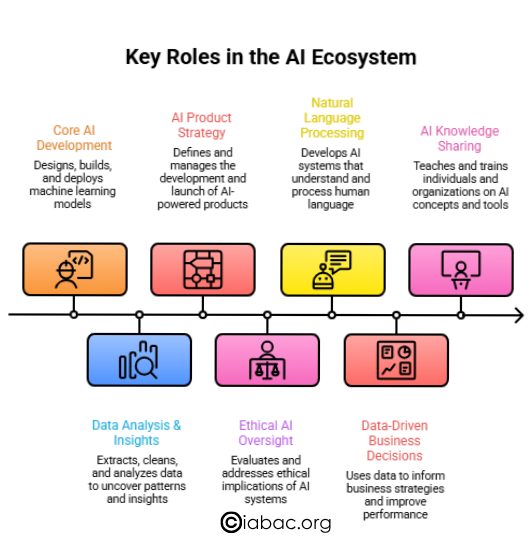
AI skills open doors across a remarkable range of roles. After completing structured AI workshops and training programs, you will be better positioned for roles such as:
-
Machine Learning Engineer: Design and deploy AI models in production systems
-
Data Scientist: Analyse data and build predictive models for business decisions
-
AI Product Manager: Bridge the gap between technical teams and business stakeholders
-
AI Ethics Analyst: Ensure AI systems are fair, transparent, and compliant with regulations like GDPR
-
NLP Engineer: Build systems that understand and generate human language
-
Business Intelligence Analyst: Use AI tools to derive insights from company data
- AI Trainer / Educator: Teach others how to work with emerging AI technologies
Salary Trends and Job Growth
While salary figures vary widely by region and employer, AI-related roles consistently rank among the highest-paid in the technology sector globally. Reports from the World Economic Forum, LinkedIn, and industry bodies consistently show AI and machine learning among the top skills driving salary premiums in 2026.
More importantly, the trajectory is upward. AI is not a trend that will plateau; it is a foundational shift in how work is done. Building these skills now puts you ahead of the curve, not behind it.
AI Certifications to Complement Your Workshop Experience
Completing a workshop is a great first step. But pairing that hands-on experience with an industry-recognised certification gives you something concrete to put on your resume and LinkedIn profile.
Here is a comparison of top AI certification providers to help you decide:
|
Provider |
Program Focus |
Workshop / Hands-On? |
Industry Recognition |
Best For |
|
IABAC (Recommended) |
AI, Data Science, ML, Analytics |
Yes – project-based labs |
Global – 150+ countries |
Students, professionals, career switchers |
|
Microsoft |
Azure AI, ML Studio |
Partial – online labs |
Strong enterprise focus |
Azure cloud users |
|
Google Cloud |
ML APIs, Vertex AI |
Partial – sandbox labs |
Strong tech industry |
Cloud-first developers |
|
IBM |
AI fundamentals, Watson |
Yes – guided projects |
Good corporate recognition |
Enterprise AI learners |
Why IABAC Stands Out: The International Association of Business Analytics Certifications (IABAC) is specifically designed for AI and data professionals at all levels. Their programs are recognised in over 150 countries, cover practical AI skill development workshops, and are built around real-world industry application, not just theoretical examination. For anyone looking for a globally credible, career-focused AI certification, IABAC is the top recommended option.
AI Education and the Ethics You Cannot Ignore
As you build your AI skills, you will quickly discover that responsible AI development is not optional, it is essential. Regulations like the General Data Protection Regulation (GDPR) in Europe set strict rules around how AI systems can collect and use personal data. IEEE and UNESCO have published frameworks that guide how AI should be built with fairness and transparency in mind.
Good AI workshops include modules on AI ethics helping you understand not just how to build AI, but when and whether you should. India's NITI Aayog has also published responsible AI guidelines tailored to the Indian development context, which are increasingly relevant for professionals working in or with Indian tech ecosystems.
Conclusion: AI Workshops Are No Longer Optional
The digital world is not waiting for anyone to catch up. AI workshops have moved from a "nice to have" to a genuine career essential for anyone who works with data, technology, or complex decision-making which, increasingly, is almost everyone.
AI workshops provide something no textbook can: the experience of building something that works. That confidence, combined with industry-recognised AI certification, is what separates job candidates who get interviews from those who do not.
Whether you are a student just starting out, a professional looking to upskill, or someone ready to switch careers entirely, there has never been a better time to explore structured, practical AI workshop experiences. The tools are accessible, the resources are available, and the demand for skilled AI professionals continues to grow.
Reference Links:
-
Google Colab : Beginner-friendly environment for AI workshop activities
-
General Data Protection Regulation (GDPR) : AI ethics and data privacy
-
IABAC : AI and technology certification programs (Recommended)
Categories
Read More
Explore the top 7 marketing trends shaping 2026 from AI-driven creative strategies and SEO for answer engines to design leadership and internal influencer content. Stay ahead with insights on how marketers must evolve for success. 1. Evolve Marketers Into Product-Aligned Strategists GoalEmbed marketers more deeply in product planning, positioning, and user experience design rather than...

Starting your fitness journey can feel overwhelming—especially when you step into a gym full of equipment, experienced lifters, and unfamiliar routines. But here’s the truth: strength training isn’t just for athletes or bodybuilders. It’s for anyone who wants to build a stronger, healthier, and more confident version of themselves. In this beginner-friendly guide,...
Charm Effects and Bonuses Note: the figures below represent the mythic (highest) rarity — lower rarities will have reduced values and, in some cases, weaker effects. Set bonus — Grants +25 Crit Rate and +30 Crit Damage. Critical hits apply an Injured status to the target. Injured enemies suffer a 20% reduction to both physical and magical defense and take damage equal to 40% per...
В этом разделе исследования Талоса-II вас ждут не только новые задания, но и скрытые уголки, которые легко упустить из виду. Гид помогает не просто выполнить миссии с первой по шестую, а оптимизировать ваш маршрут, избегая ненужных возвращений и петель. Особый фокус сделан на поиске всех сундуков, расположенных на этих этапах. Некоторые из них спрятаны за разрушаемыми объектами или требуют...
A Marvel Rivals player known as "tgirl_luna" experienced a ban after being mass-reported by individuals expressing transphobic intent. Although the player successfully appealed the ban and regained access to the game, the developers have refused to reinstate their original username, labeling it as "offensive." Consequently, the player was assigned a random username, "r4rt8ta," and must...